
“Miss You, My Mirror Dream” Marks the First Experiment and Official Launch of Quantum Art Thailand
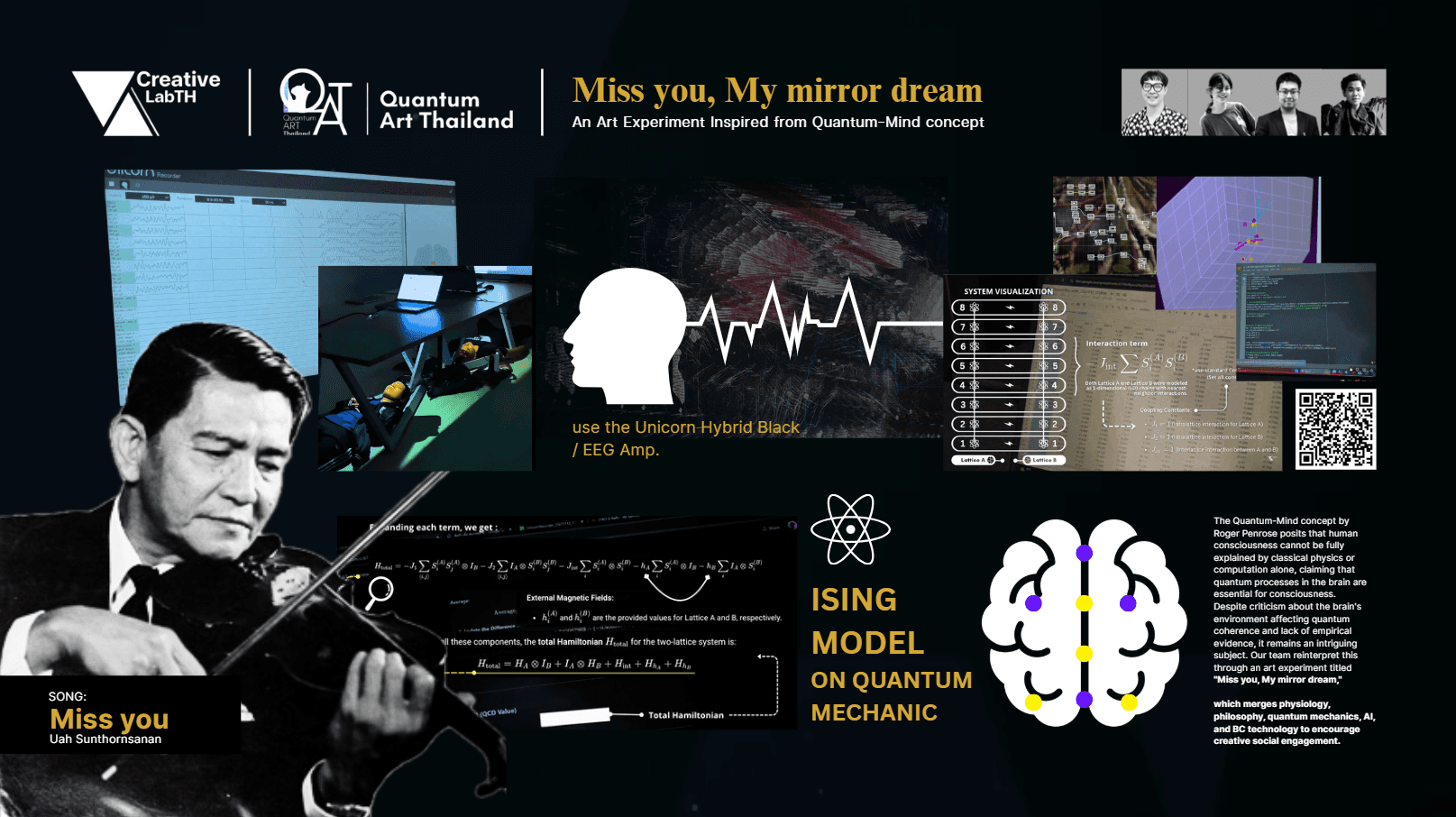
Quantum Art Thailand officially debuted with “Miss You, My Mirror Dream,” an art experiment inspired by the controversial Quantum Mind concept. Rather than treating the theory as a scientific claim, the project transforms questions about consciousness, memory, dreams, and human connection into an interdisciplinary artistic exploration through quantum physics, philosophy, AI, BCI technology, physiology, and contemporary art.
On November 17, 2024, Quantum Art Thailand, or QAT, officially introduced its first public art experiment under the title “Miss You, My Mirror Dream.” The project marked the first official launch of the platform, which was founded to explore the intersection between quantum physics, philosophy, consciousness, technology, and contemporary art.
At the center of the project is one bold question: if the human mind is still one of the deepest mysteries in science, can art become a space where difficult, controversial, and unfinished scientific ideas are explored in a more open way?
“Miss You, My Mirror Dream” was inspired by the Quantum Mind concept associated with physicist Roger Penrose. The idea suggests that human consciousness may not be fully explained through classical physics or conventional computational models alone. In this view, quantum mechanical processes inside the brain may play a role in shaping conscious experience, perception, and awareness.
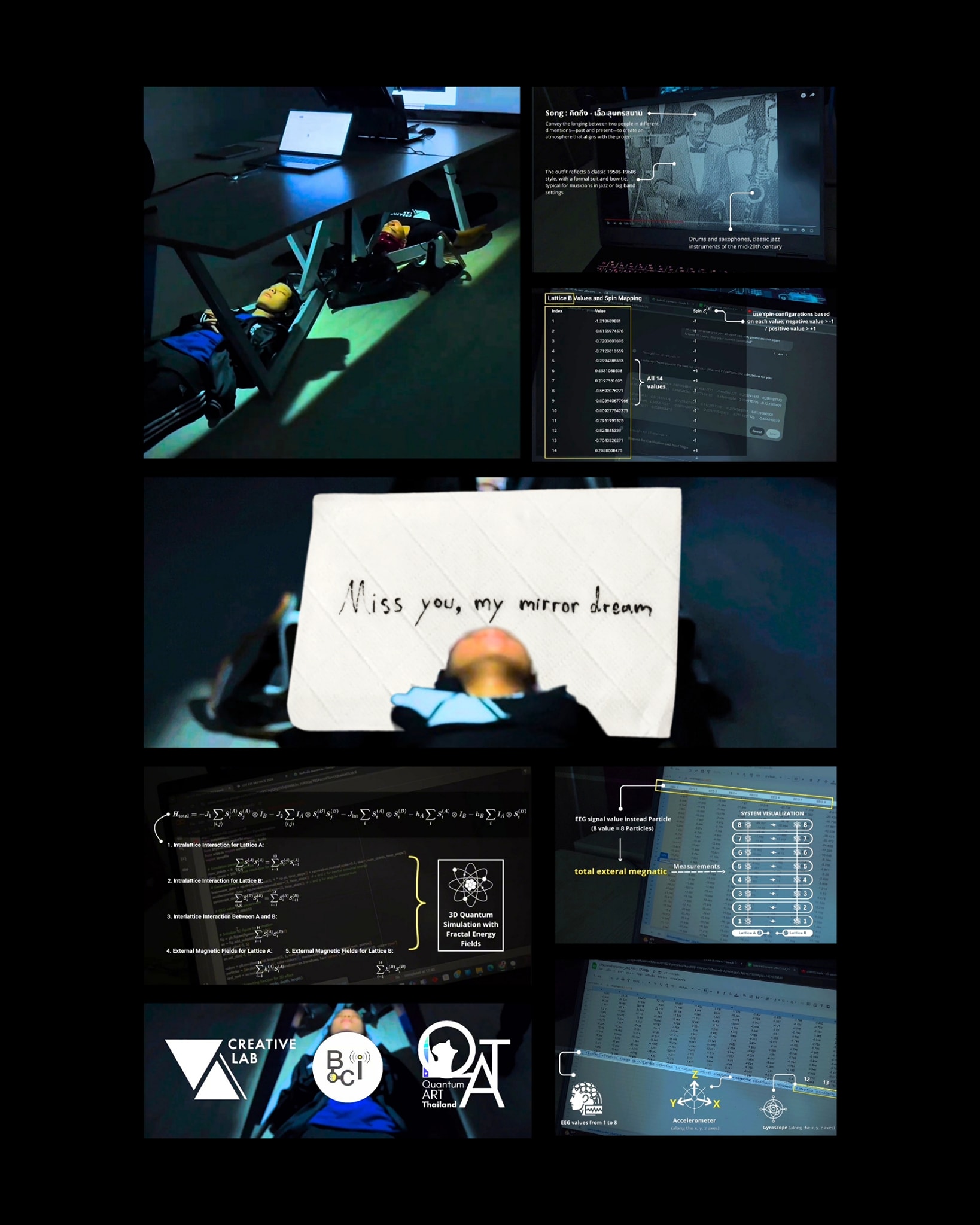
For QAT, this tension is exactly what makes the idea powerful as an artistic starting point. Instead of asking audiences to believe in Quantum Mind as science, “Miss You, My Mirror Dream” asks a different question: if this concept remains highly uncertain in scientific research, what happens when it is reinterpreted through art?
The result is an art experiment that connects physiology, philosophy, quantum mechanics, artificial intelligence, brain-computer interface technology, and contemporary art. The project uses the language of quantum theory not as a fixed answer, but as a metaphorical and experimental framework for thinking about how human minds bond, reflect, remember, and dream.
The title “Miss You, My Mirror Dream” carries this emotional and philosophical direction. “Miss You” refers to memory, longing, and the invisible emotional connection between people. “Mirror” suggests reflection, identity, self-recognition, and the way one mind may respond to another. “Dream” opens a space between reality and imagination, between measurable signals and subjective experience.
Through this title, the project invites audiences to think about the mind not only as a biological system, but also as a field of relationships. It asks whether the connection between people can be understood only through language, behavior, and emotion, or whether there may be deeper patterns that remain unseen.
The project also explores the idea of measuring human mind-bonding through a quantum-inspired lens. This does not mean proving that two minds are literally quantum mechanically connected. Instead, the experiment uses ideas from quantum mechanics as a creative model to interpret emotional, physiological, and cognitive connection. In this sense, the project stands between science and art: grounded enough to engage with real scientific questions, but open enough to transform uncertainty into imagination.
This approach reflects QAT’s broader mission. Quantum Art Thailand was created as a platform for artists, researchers, technologists, and audiences to engage with complex scientific ideas through creative practice. Rather than separating science from emotion, or physics from lived experience, QAT aims to create a space where abstract theories can become human, visual, and socially meaningful.
“Miss You, My Mirror Dream” was created by TAE CreativeLab, Perawit Boonsomchua, and Asst. Prof. Sikarin Yoo-kong. The project was supported by Prof. Yodchanan Wongsawat’s BCI Lab.
As the first experiment of Quantum Art Thailand, “Miss You, My Mirror Dream” does not attempt to settle the debate around Quantum Mind. Instead, it opens the debate to another language: the language of art.
By transforming a controversial scientific idea into an artistic experience, QAT invites audiences to reflect on the boundary between evidence and imagination, between the measurable and the emotional, and between what science can explain today and what human creativity continues to ask.
In that sense, “Miss You, My Mirror Dream” is not only an art project. It is the beginning of QAT’s larger journey to explore how quantum science, consciousness, and contemporary art can meet in Thailand, not as separate worlds, but as mirrors of one another.

SugarNT
Comments
No comments yet. Be the first.
Sign in to leave a comment.